What Makes Perfume Sillage So Important
Most people choose a perfume based on the smell, how long it lasts, whether it feels like "them." Fair enough. But there's a part of fragrance that gets overlooked way too often, and it changes everything about how a scent actually plays out in real life. That's sillage.
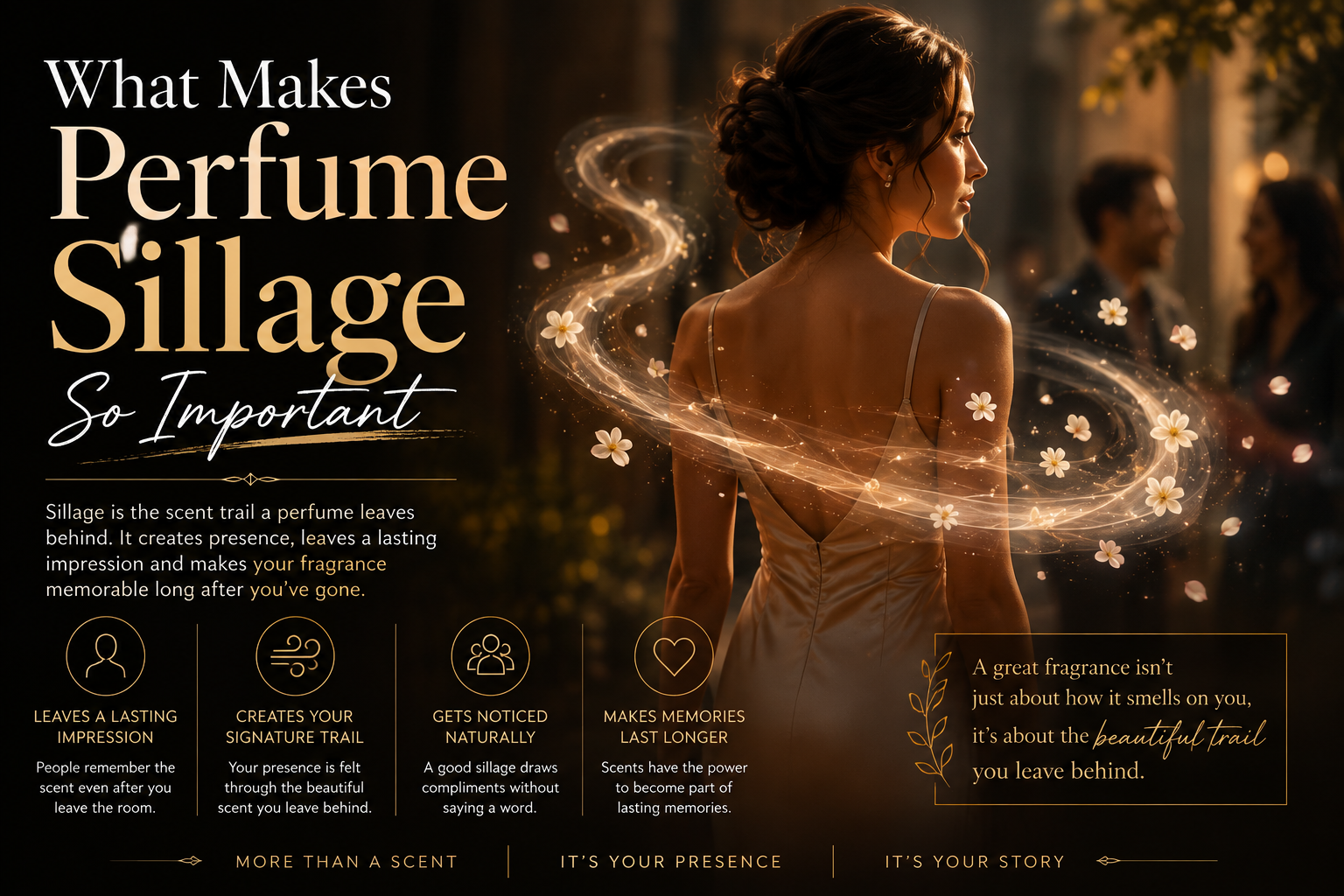
Sillage, put simply, is the trail a perfume leaves behind you as you move through a room. The faint trace still in the air after you've already left. It's not really about smelling strong. It's about leaving something behind without flattening everyone in a five-foot radius.
What sillage actually means
Someone walks past, and a couple seconds later you catch a scent that's still hanging around even though they're long gone. That's the whole idea.
It's not the same thing as sniffing your own wrist right after spraying. That's a direct, close-range read of the fragrance. Sillage happens further out — it's what other people pick up on, not what you smell standing two inches from your own arm.
Some perfumes barely leave a trace. Others fill a hallway. Neither is right or wrong on its own; it depends on the scent, where you're wearing it, what the weather's doing, even what mood you're in that day.
Why bother caring about this
Perfume is part of how people read you, alongside your clothes, your voice, whatever. Sillage is the part of that equation most people never learned to notice.
A fragrance with decent sillage adds this extra layer — someone catches a floral note as you walk by, or a hit of vanilla when you sit down next to them, or a woody trace lingering after you've already gone. Small stuff, but it's usually what actually gets remembered.
If you don't want to be reapplying perfume every two hours just to be noticed, this is the part worth paying attention to.
People confuse this with longevity constantly
Longevity is how long you personally can still smell the perfume on your skin. Sillage is whether anyone else can smell it without standing right next to you. These get lumped together all the time and they really shouldn't be.
A perfume can last on your skin for hours and still barely project past your own body. You might catch it faintly at 9pm, but the person sitting across from you at dinner has no idea you're wearing anything at all. And the reverse happens too — something can hit hard for the first hour and then basically vanish, even though technically it's "still there" if you go looking for it.
Knowing which one you actually want changes what you should be buying.
And it's not the same as projection either
Projection is how far the scent reaches while you're standing still, more or less a bubble around you. Sillage is the trail once you start moving. Standing at a bar, how far someone picks up on your perfume — that's projection. Walking away and the scent staying in the space you just left — sillage.
They're related but not interchangeable, and fragrance people will happily argue the distinction longer than the topic probably deserves.
What actually pushes sillage up or down
Concentration is one factor — extrait versus eau de parfum, generally more oil means more staying power — but it's not the whole story. Formulation and ingredient quality matter just as much, sometimes more.
Certain notes are just built to carry. Oud, amber, musk, vanilla, warm woods, spices. Citrus and aquatic scents tend to stay closer and quieter, though a well-built one can still surprise you.
Skin plays a bigger role than people give it credit for. The exact same bottle can behave completely differently depending on skin type, hydration, body heat. That's why a scent can feel huge on one person and almost nonexistent on another wearing the identical fragrance.
Weather does something similar — heat and humidity push molecules further out, cold weather pulls scent in closer to the skin. A perfume that performed beautifully in July might do almost nothing in January.
And how you apply it matters. Pulse points — wrists, neck, behind the ears — let it warm up naturally with body heat. Spraying more doesn't automatically mean it travels further; a lot of the time it just means the person next to you on the bus is having a rough commute.
Bigger trail isn't automatically the goal
A big, loud sillage is great at a wedding or a night out. It's not great in a small meeting room, a crowded elevator, or a quiet office. People notice — and not always in a good way.
Match it to where you're going. Office, keep it close to the skin. Date night, go a little warmer and bolder. Big event, this is when a stronger trail actually works in your favor.
How to actually judge sillage before you buy something
Don't decide anything in the first thirty seconds after spraying — that's just the top notes doing their thing, and they burn off fast. Give it time on your skin, move around, come back to it later.
Honestly the most useful thing you can do is ask someone else standing at a normal talking distance whether they can smell it. That tells you more than repeatedly smelling your own wrist ever will.
If a bigger trail is the goal, orientals, woody scents, ambers, gourmands, and oud-heavy blends are usually where people land.
Why any of this actually matters
Scent gets tied to memory in a way almost nothing else does. Someone smells something years later and suddenly they're back at a specific moment they hadn't thought about in ages.
Sillage is a big part of why that happens, because the scent doesn't stay locked to the person wearing it — it drifts into hallways, cars, other people's memory of a night they can barely place anymore. Someone can remember exactly how you smelled long before they remember anything you actually said.
That's really the whole point of caring about this in the first place. The best compliment a perfume gets isn't "you smell nice." It's someone catching a trace of it ten minutes after you've already left and wondering where it came from.